
Introduction: Open Educational Resources in Higher Education

Open Educational Resources (OER) represent a transformative approach to educational content that prioritizes accessibility, affordability, and adaptability. These freely available, openly licensed materials include textbooks, course modules, videos, assessments, and entire courses that educators can use, modify, and share without restrictions on copyright. As textbook costs continue to burden students, OER provides a viable alternative that maintains academic quality while eliminating financial barriers to learning.

This blog post highlights five high-quality OER platforms that URI faculty can integrate into their courses. These resources require no special software, are completely free to access and use, and offer content across virtually every academic discipline.

TOP 5 OER PLATFORMS

1. LibreTextsWebsite: https://libretexts.org/

LibreTexts is one of the world’s largest OER platforms, providing free, openly licensed textbooks across multiple disciplines, including Biology, Chemistry, Physics, Mathematics, Humanities, and Social Sciences. All materials are peer-reviewed, regularly updated, and designed to replace expensive commercial textbooks while maintaining academic rigor. Faculty can adopt existing textbooks, remix content from multiple sources to create custom materials, or build entirely new resources using the platform’s authoring tools. LibreTexts integrates with learning management systems and includes built-in assessment tools and analytics, making it an excellent resource for reducing textbook costs while delivering high-quality, customizable educational content.

2. OpenStaxWebsite: https://openstax.org/

OpenStax is  a nonprofit initiative based at Rice University that provides free, peer-reviewed textbooks for high-enrollment college courses. The platform offers over 50 textbooks covering introductory courses in Biology, Chemistry, Physics, Math, Economics, History, Psychology, and Sociology. Each textbook undergoes rigorous peer review by faculty experts and is available in web view, PDF download, and low-cost print editions. OpenStax also provides supplementary resources such as instructor presentations and LMS integration packages. With over 6 million students using OpenStax materials and documented savings exceeding $1.5 billion in textbook costs, this platform offers a proven solution for zero-cost course materials.

3. OER CommonsWebsite: https://www.oercommons.org/

OER Commons is a comprehensive digital library providing access to over 500,000 open educational resources from around the world. OER Commons aggregates diverse content types, including full courses, modules, lesson plans, videos, simulations, and assessments across all disciplines. The platform offers advanced search capabilities, user reviews, ratings, and usage statistics. Faculty can create personal collections, align resources to learning standards, and remix existing materials using built-in authoring tools. The platform’s social networking features enable educators to connect, collaborate, and share best practices, making it both a resource repository and a professional community for OER implementation.

4. MIT OpenCourseWareWebsite: https://ocw.mit.edu/

MIT OpenCourseWare provides free access to course materials from over 2,500 MIT courses spanning undergraduate and graduate levels. The platform publishes actual course content, including syllabi, lecture notes, assignments, exams, videos, and interactive simulations from MIT’s Engineering, Science, Mathematics, Business, and Humanities departments. While not designed as a degree substitute, OCW provides valuable supplementary materials and teaching resources that faculty can adapt for their own courses. Video lectures are particularly valuable for flipped classroom models, and problem sets and exams make excellent practice materials. All materials are openly licensed for adaptation and redistribution.

5. Open Textbook LibraryWebsite: https://open.umn.edu/opentextbooks/

The Open Textbook Library, managed by the University of Minnesota, provides a curated collection of over 900 openly-licensed textbooks organized by academic discipline. Each textbook includes detailed faculty reviews evaluating accuracy, relevance, clarity, and pedagogical effectiveness, helping instructors make informed adoption decisions. The library covers Arts, Business, Education, Humanities, Mathematics, Medicine, Science, and Social Sciences. All textbooks are available for free PDF download, with many offering editable formats for customization and low-cost print options. The platform includes Pressbooks, an authoring tool that enables faculty to create, edit, or remix their own open textbooks, making it a comprehensive solution for both OER adoption and content development.

Technology is one of the many challenges that many higher education institutions face today. Providing reliable access to computing resources, storing vast amounts of data securely, and scaling systems to meet demand are essential components of a modern academic environment. Cloud computing offers solutions that can transform how colleges and universities support their missions of teaching, learning, and research.

Amazon Web Services (AWS) is a comprehensive cloud computing platform that provides on-demand access to computing power, storage, databases, and other IT resources. Rather than maintaining expensive physical servers and data centers, institutions can access these resources through the cloud, paying only for what they use. AWS has become a cornerstone of digital transformation in higher education.

AWS can serve as a flexible technology foundation for academic institutions. It can help universities scale resources during peak registration periods, support computationally intensive research projects, and provide students with hands-on experience using industry-standard tools. At URI, AWS infrastructure could support various teaching and learning needs by providing secure, scalable, and cost-effective technology solutions. For example, AWS can:

  • Enable virtual labs and development environments where students can practice real-world technical skills
  • Host learning management systems and student applications such as Brightspace that need to scale during high-traffic periods for example around final exams.
  • Provide computing power for research projects requiring data analysis, machine learning, or simulation
  • Offer secure storage solutions for institutional data, research materials, and digital archives

Imagine a faculty member teaching a data science course. Students need access to powerful computing resources to analyze large datasets and build machine learning models, but the university’s physical computer labs have limited capacity. Using AWS, the instructor sets up virtual environments where each student has their own workspace with the necessary tools and computing power. Students can access these resources anytime, from anywhere, completing assignments on their own schedules. This flexible approach highlights an important benefit for teaching and learning: it removes barriers to access, enables hands-on practice with industry tools, and prepares students for careers where cloud computing skills are in high demand.

Visual for digital transformations

While AWS cannot replace the expertise of IT professionals and educators, it enhances institutional capabilities by providing enterprise-grade infrastructure without the capital investment of building and maintaining physical data centers. It allows universities to respond quickly to changing needs, experiment with new technologies, and focus resources on their core educational mission rather than infrastructure management.

AWS services, available through institutional partnerships and education programs, support teaching and learning by providing students with hands-on experience using the same tools employed by leading organizations worldwide. Programs like AWS Educate and AWS Academy offer free resources, training, and credits specifically designed for educational institutions. By combining cloud infrastructure with thoughtful pedagogical design, educators can create more dynamic, accessible, and career-relevant learning experiences. At the same time, AWS is just one option among many cloud providers, and institutions can decide whether it aligns with their strategic priorities and technical requirements.

AWS is a partner in innovation. It helps institutions modernize their technology infrastructure, expand access to powerful computing resources, and prepare students for a workforce increasingly built on cloud technologies. By supporting flexibility, scalability, and experimentation, AWS makes advanced technology more accessible and cost-effective for both students and educators.

Originally published summer 2025 – Updated enabled in all courses August 28, 2026.

D2L is implementing a New Content Experience in Brightspace here at URI. It is a change in your content screen, where the content already developed takes a more intuitive and efficient process for delivering materials and improves the student digital learning experience. Creating new courses and content will be easier and involve less screens and passthroughs. This will affect both Brightspace and Engage.
When: The New Content Experience will be enabled in all courses starting August 2026.
Transition Period: This began in late August 2025. You can easily switch between Classic and New Content Experience as you explore the interface at your own pace. We encourage you to try NCE in advance, so it feels familiar by the time it becomes the default. At present, faculty may ‘opt in’ to try it out for you and your students.

Helpful Videos

No action is required on your part—your existing content will remain in place, and you’ll see the updated interface the next time you access the Content tool. This upgrade will make it easier for you to build and organize content while helping your learners to stay engaged and on track with their learning.

Highlights include:

icon for new content design concept

Modern and Streamline Design

  • Clean, visual layout with color-coded modules for better organization
  • Simplified workflows that reduce time spent on course management
  • Intuitive navigation that helps learners find what they need quickly

Brightspace IntegrationSeamless Integration with Brightspace Tools

  • Direct access to Assignments, Quizzes, Discussion, and LTI links within the Content tool
  • Fewew clicks and no more switching between tabs
  • Frequent course activities you need in one centralized location

Device icon

Mobile-Friendly and Accessible

  • Purposely designed to support accessibility needs
  • Responsive design that works smoothly on mobile, tablet, or desktop

We’re excited for you to experience this improved interface and are here to help every step of the way.
TLS Team

Public speaking is a skill that challenges many students and educators alike.  Speaking clearly, engaging an audience, and organizing ideas effectively are essential components of successful communication.  Artificial intelligence (AI) offers tools that can support the development of these skills in the context of teaching and learning.

Image conveying AI and the Art of Effective CommunicationAI can serve as a digital rehearsal partner. It can help students and faculty draft outlines, refine language, and anticipate audience questions. At URI, AI tools such as Microsoft Copilot can support public speaking preparation by helping users draft outlines, generate ideas, and explore effective ways to engage an audience. For example, AI can:


  • Suggest compelling openings or introductions
  • Rephrase complex sentences for clarity
  • Identify repetitive words or awkward phrasing
  • Generate potential audience questions to practice answering

Imagine a student preparing for a class presentation.  They ask AI to suggest a few ways to open their talk.  The AI offers three different approaches: a surprising statistic, a thought-provoking question, and a short anecdote.  The student chooses one, refines it, and practices delivering it aloud.  This iterative process highlights an important lesson in teaching and learning: it allows students to experiment, gain confidence, and improve before presenting in front of their classmates, reinforcing the value of reflection, practice, and growth.

While AI cannot replace the human element of communication, it enhances learning by providing immediate feedback and encouraging experimentation with language and delivery.  It allows students to practice in a low-stakes environment and gain confidence before presenting in front of their peers.

Tools like these, available to URI students and faculty, support teaching and learning by helping students strengthen communication skills, improve clarity, and build confidence in public speaking.  By combining AI feedback with traditional instruction and practice, educators can create more engaging, effective learning experiences.  At the same time, AI is just one option among many, and faculty can decide whether it aligns with their teaching approach and course goals.

AI is a partner in preparation.  It helps learners refine their ideas, experiment with phrasing, and practice delivery so that when they do speak, they do so with clarity, confidence, and impact.  By supporting reflection, iteration, and revision, AI makes the process of becoming a stronger communicator more accessible and effective for both students and educators.Ready to take your next presentation to the next level?  Try using Microsoft Copilot or another supported AI tool for your upcoming talk, and discover how it can help you craft, refine, and deliver your ideas with confidence.

In the fast-paced world of technology, staying updated with the latest advancements is essential. At Tech Day 2025, we hosted a session focused on the evolution of Artificial Intelligence (AI) within Apple’s ecosystem. Here’s a look at the key insights from the event.

Apple’s AI Toolset: A Look Into the Future

Apple has consistently pushed the boundaries of technology, and its suite of AI offerings is no exception. As we look ahead to 2026, Apple Intelligence will continue to evolve and add new tools and features to the Apple ecosystem. Here’s what we learned about Apple’s journey in AI:

  • Evolution: Most users will be familiar with Apple’s first big push into a public AI tool…Siri. Today, Apple has expanded Siri’s skillset and added other features, branding it’s comprehensive range of AI tools as Apple Intelligence. These tools are seamlessly integrated across (select) iPhone, iPad, and Mac devices. 

  • Integration: Apple Intelligence is designed to work across various Apple devices, including iPhones, iPads, and Macs. While the core functionalities remain consistent, each device offers unique capabilities tailored to its specific hardware.

  • Compatibility: Apple Intelligence tools require Apple hardware to function but are increasingly compatible with non-Apple software. This makes them versatile and accessible to a broader audience without compromising on performance.

  • Ongoing Developments: It’s important to note that Apple still advertises Apple Intelligence as a BETA release, indicating ongoing enhancements and updates that users can look forward to.

Key Features of Apple’s AI Tools

Apple’s AI tools are packed with features designed to elevate the user experience across a wide range of applications:

  • Writing Tools: Enhance your writing process with AI features such as proofreading, rewriting, tone adjustment (professional, friendly, concise), summarization, composition, and the ability to create lists and tables effortlessly.

  • Safari Document Summarization: When using Reader View in Safari, easily condense lengthy documents into concise summaries.

  • Generative AI Image Creator: Explore creativity with the Image Playground, a generative AI tool for crafting unique images.

  • Personalized Enhancements: Enjoy features tailored for personal use, such as generative emojis, advanced photo editing and search capabilities, and smart replies and summarization in the Apple email client.

  • Audio Tools: Effortlessly transcribe and record audio with built-in transcription and recording features.

Apple Intelligence Security and Confidentiality

As we leverage the power of AI tools, it is crucial to remain vigilant about security and confidentiality. Here are some important considerations to keep in mind:

  • Data Privacy: Be mindful of the data you enter into AI tools. Once input, this data may contribute to training algorithms.

  • Copyright and Trademarks: Ensure that any content used with AI tools respects existing copyrights and trademarks.

  • Confidentiality: Exercise caution when handling sensitive or proprietary information within AI platforms, as unintended exposure could compromise data integrity.

  • Pairing with External Platforms: Many Apple AI features, such as those unlocked when paired with third-party platforms like OpenAI’s ChatGPT, require careful consideration of the associated security implications.

Written by Jim McGwin, College of Business

The convergence of artificial intelligence (AI) and quantum computing is catalyzing a historic transformation: the Fourth Industrial Revolution (4IR), also known as the Intelligent Age. This era goes far beyond digitization. It signifies the fusion of physical, digital, and biological systems, accelerated by exponential advances in computing power and algorithmic intelligence. At the heart of this revolution lies the hybrid combination of classical AI computing and quantum technologies that promises to redefine every sector of industry and society.

Image Symbolizing AI and Industry

4IR is not driven by any one innovation but by the integration of many. AI, robotics, Internet of Things (IoT), biotechnology, and quantum computing are forming robust cyber-physical systems. These platforms dissolve boundaries between digital software and real-world hardware. For example, AI-powered quantum algorithms can optimize supply chains or simulate molecular interactions at speeds unthinkable with classical machines. The outcome is not merely faster computation, but the ability to reimagine processes, products, and industries.

Unlike previous industrial revolutions, which took decades to mature, this one moves at an exponential rate. Thanks to AI’s adaptive learning and quantum processing scale, what once took years can now be executed in weeks. Posts across the web and social platforms reflect this rapid acceleration, particularly with recent breakthroughs like Google’s Willow chip and D-Wave’s advanced processors, both of which edge us closer to practical quantum applications.

Quantum computing’s strength lies in its ability to handle complexity. AI excels at finding patterns. Together, they form a force multiplier. Quantum machine learning (QML) has the potential to enable faster and more efficient training of AI models. AI, in turn, helps correct quantum computing errors and manage noisy systems. This convergence could unlock new capabilities in fields from drug discovery to logistics to climate modeling.

AI is now at the center of strategic decision-making. At Davos 2025, executives across various industries emphasized the need to integrate generative AI and predictive analytics into every workflow. In healthcare, AI-driven models are boosting diagnostic accuracy by up to 50%. In manufacturing, AI enhances efficiency while reducing costs and design bias.

Chart for Global Investment in Quantum Computing Hardware

Quantum computing is no longer hypothetical. With over $35 billion invested as of 2022 and projections of $125 billion by 2030, quantum hardware is fast approaching utility-grade performance. Key players, such as IBM and D-Wave, are delivering systems that tackle problems classical computers cannot, optimizing traffic routes, simulating materials, and enhancing cryptography.

AI and quantum technologies aren’t evolving in silos. AI optimizes quantum computing error correction, while quantum expands AI scalability, edging closer to Artificial General Intelligence (AGI). Semiconductors, cloud infrastructure, and blockchain are all intersecting to build a layered ecosystem of disruption.

Quantum-AI tools, such as Kvantify’s drug modeling platforms, drastically reduce R&D timelines. AI applications, such as those developed by DeepMind, can detect diseases with greater speed and accuracy. While some jobs may be displaced, new roles in quantum-AI integration are emerging.

  • Finance Quantum computing’s potential to break encryption threatens existing systems but opens new frontiers in portfolio optimization and fraud detection. Financial institutions already leverage AI for risk modeling and algorithmic trading; quantum will further elevate these capabilities.
  • Manufacturing and Supply Chains Generative AI designs complex systems, while quantum computing improves logistics and production efficiency. FedEx’s experimentation with QAOA-based routing optimization is a prime example of this trend. Traditional roles may shrink, but jobs in quantum literacy and AI-augmented design are expected to grow.
  • Sustainability Quantum simulations are advancing renewable energy systems and materials science. AI already enables precision agriculture and resource optimization, and Colombia’s farms achieved 30% cost reductions using AI and IoT. Add quantum, and sustainability becomes more innovative and more scalable.
  • Cybersecurity Quantum poses risks to current encryption methods but offers solutions too, like quantum key distribution (QKD). AI strengthens threat detection and response. Organizations must pivot fast to quantum-safe systems or face critical vulnerabilities.

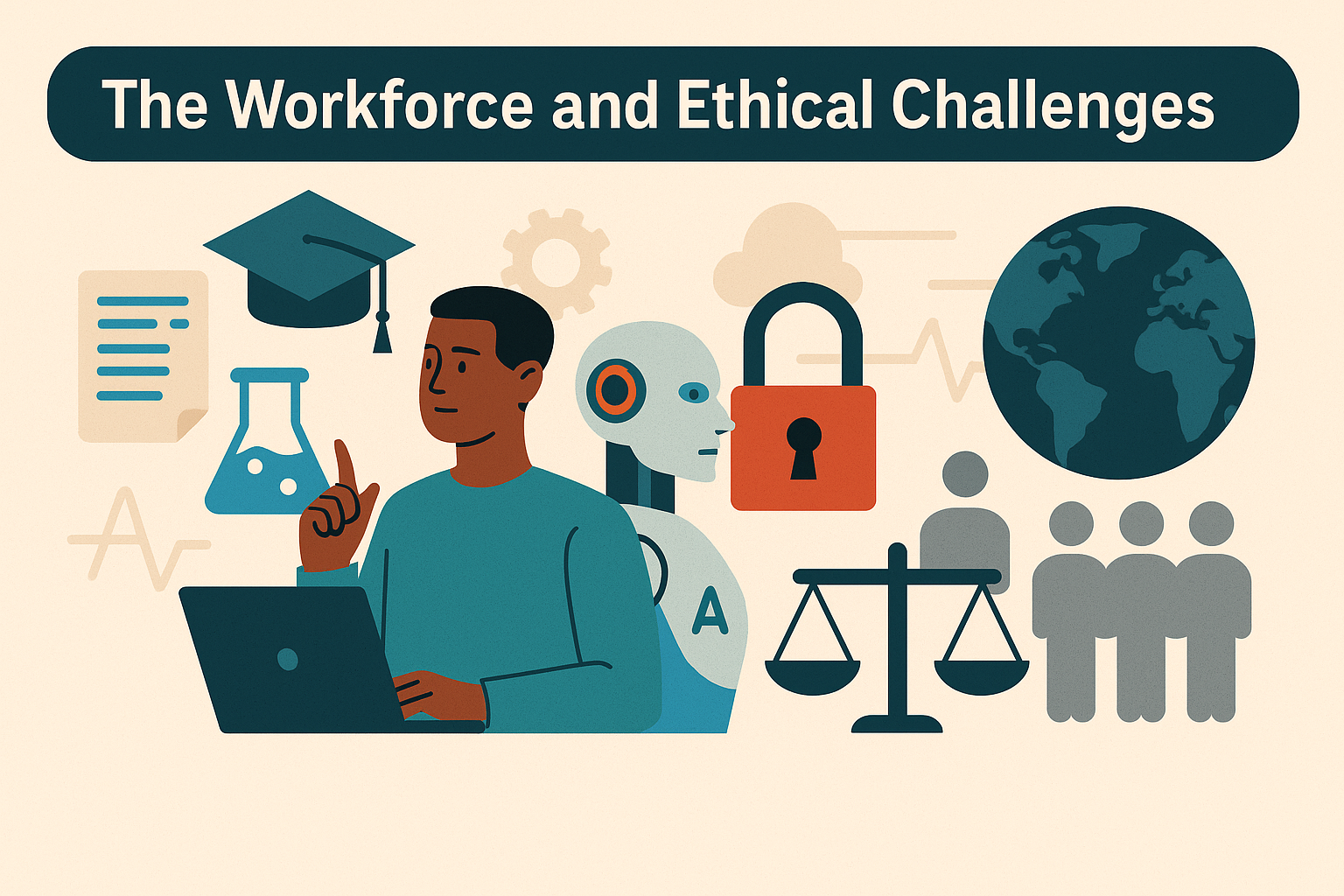
Picture depicting workforce and ethical challenges

The Workforce and Ethical Challenges

Some traditional roles are being eliminated, while new positions in AI ethics, quantum software, and hybrid system management are emerging. Workers who learn to innovate alongside machines, rather than being replaced by them, will thrive. Industry leaders like Sam Altman and Andrew Ng emphasize the importance of learning to utilize AI as a collaborator, rather than just a tool.

There is an urgent need to teach AI and quantum fluency across all education levels. AI skills (e.g., TensorFlow, generative tools) and quantum basics (e.g., Qiskit, linear algebra) must be integrated into curricula. Online platforms and micro-certifications are becoming increasingly crucial in democratizing access.

From privacy risks to the concentration of power among tech giants and nations, the ethical and political stakes are rising. Quantum’s ability to break encryption raises concerns about surveillance and weaponization. Transparent policies, open-source initiatives, and international cooperation are essential.

Looking Ahead

The Intelligent Age holds the promise of abundance, new cures, smarter cities, and climate solutions, but only if navigated wisely. As quantum and AI technologies evolve, they will reward creativity, collaboration, and discernment. The real challenge is not technological but human: Can we build the infrastructure, policies, and skills to keep pace? Can we avoid widening inequality while seizing shared opportunity?

“In the disruptive age of AI, where knowledge is free and abundant, human discernment and wisdom are essential for managing risk and reward, as well as creating and innovating. This is the true value people bring to every industry.” 

Looking for a way to guide students through your course in a more structured way? Brightspace offers a feature called Release Conditions that helps you do just that. It allows you to tailor access to course content based on a student’s progress, performance, or group membership—making it easier to support learning at the right pace for each individual.

What Are Release Conditions?

Release Conditions are rules you can attach to content, activities, or even announcements in your course. When a student meets the condition—such as completing an assignment, achieving a quiz score, or being part of a group—they gain access to the next item. These conditions make it easier to deliver content in a logical sequence and provide individualized support when needed.

How Can Instructors Use Release Conditions?

Release Conditions give you simple ways to guide student progress, personalize learning, and create a more engaging course experience. Here are some practical ideas for how you might use them:

  • Keep students on track: Want to make sure students complete one module before moving on to the next? You can set conditions so content unlocks only after a previous activity—like a quiz or assignment—is completed.
  • Support students who need extra help: You can automatically show additional resources or practice activities to students who score below a certain percentage on a quiz, giving them a chance to review before moving forward.
  • Customize learning by group: Teaching multiple sections or using groups for projects? Release different instructions, readings, or activities based on group membership—all within the same course shell.
  • Motivate participation: Unlock feedback, extra credit, or bonus materials once students complete a discussion post or survey.

How to Set a Release Condition?

To set a Release Condition in Brightspace, simply edit the item you want to restrict, choose the appropriate condition—such as quiz completion or group membership—and save your changes.

Visit the how-to guide in the URI Knowledge Base for step-by-step instructions.

Tips for Using Release Conditions Effectively

Release Conditions can enhance your course when used thoughtfully. To make the most of this feature:

  • Let students know what to expect. Be clear about which activities unlock content and why—it builds trust and reduces confusion.
  • Use only when it adds value. Don’t overuse conditions. Apply them when they meaningfully support pacing, personalization, or participation.
  • Test from the student’s view. Use “View as Student” to ensure content appears as intended and that students won’t hit unexpected roadblocks.
  • Adjust as needed. If students seem confused or if conditions aren’t working as planned, don’t hesitate to revise them mid-course.

Release Conditions are a great way to help students stay organized, meet learning goals, and move through your course at a pace that works for them. If you’re interested in trying this out or want help brainstorming how it could fit your teaching style, please feel free to reach out to the IT Teaching and Learning Services team.

Brightspace by D2L is a robust and flexible learning management system (LMS) with tools that empower both educators and learners. Yet many of its best features often go unnoticed. Whether you’re a Brightspace veteran or a newcomer, here are some key tips and tricks to help you streamline your course management and elevate the learning experience.

Bulk Edit: Save Time with Course-Wide Adjustments

The Bulk Edit feature within a course’s Table of Contents allows instructors to quickly make changes to multiple content items at once—a major timesaver during course setup or mid-semester adjustments.

What You Can Do:

  • Rename multiple topics or modules.
  • Add or update due dates and availability settings.
  • Change visibility (e.g., hide/publish multiple items at once).

This is especially helpful after copying course content from previous terms and needing to quickly reset dates or update naming conventions.

Pro Tip: Use Bulk Edit in conjunction with Manage Dates (next section) for efficient pre-semester setup.

Go to Guide: Bulk Edit Modules & Topics

Icon representing a checkmark

Manage Dates: Keep Your Course Schedule in Sync

When transitioning your course from one semester to another, the Manage Dates tool is your go-to resource. It gives you a centralized view of all start, due, and end dates across:

  • Assignments
  • Quizzes
  • Discussions
  • Content modules & topics

You can easily shift all dates forward or backward using the Bulk Offset feature, or selectively adjust individual deadlines.

Go to Guide: Bulk Editing Dates using Manage Dates 

Icon representing calendar

Notifications: Stay Informed, Keep Students Engaged

Brightspace’s Notification System helps both instructors and students stay updated on important course activities. All new user accounts are configured to receive course announcement emails by default. Users may opt out of these notifications if they choose to.

Alerts Include:

  • Assignment submissions
  • Discussion activity
  • New content or announcements
  • Grade updates

You can choose to receive notifications via email, SMS, or both.

🎯 Instructor Insight: Instructors, please encourage your students to adjust notifications at the beginning of the semester. This significantly improves student engagement, reduces missed deadlines, and supports proactive learning habits.

Go to Guide:  Managing Brightspace Notifications

Icon representing notifications

Assignment Categories: Organize and Simplify Grading

Assignment Categories allow instructors to group related assignments under specific headings in the Assignments tool. While they don’t impact grading calculations (unlike gradebook categories), they provide:

  • Clearer structure for students
  • Easier navigation
  • Better course organization for instructors

Example: Group weekly reflections under a “Journals” category or segment quizzes by unit.

Note: Assignment categories are distinct and separate from gradebook categories. Assignment categories are purely for aesthetic purposes while gradebook categories serve a function.

Go to Guide: Assignment Categories

Icon representing structure and outline

Enabling Final Grades for Students: Ensure Visibility

By default, final grades in Brightspace are not visible to students. Final Grades do not have to be just for the end of the term, it can be a useful tool to show students where they stand in the course as the term progresses. To share them, you need to both calculate and release the final grade explicitly. 

Why It’s Useful:

  • Encourages self-monitoring: Students can track their progress in real time.
  • Reduces grade-related anxiety: No surprises at the end of the term.
  • Improves transparency: Shows how each activity contributes to the overall grade.
  • Supports formative feedback: Helps students understand where to improve.

Pros and Cons of Treating Ungraded Items:

  • Drop ungraded items:
    • Pro: Allows students to see a more realistic representation of their performance as ungraded items don’t artificially lower their grade.
    • Con: Instructors must manually enter zeros for incomplete items to ensure accurate final grade calculations.
  • Treat ungraded items as 0:
    • Pro: Ungraded items are automatically treated as zeros which eliminates the need for manual input by instructors.
    • Con: Any item that isn’t completed or has yet to be assigned will make the final grade inaccurately lower than the true performance of the student.

Go to Guide: Releasing Final Grades to Students

Icon representing final grade topic

Final Thoughts

With these Brightspace tips and tricks in your toolkit, you can simplify your course management, increase efficiency, and foster a more responsive and engaging learning environment for your students. 

But that’s not all! Don’t be afraid to explore the platform further as Brightspace is full of hidden gems waiting to be discovered.

Looking for step-by-step instructions? Be sure to visit our Knowledge Base or explore D2L’s Brightspace Community for detailed documentation, video walkthroughs, and community forums.

Education is about creating pathways to success for all students, and accessibility tools play a key role in making that possible. By offering inclusive learning support, we reduce barriers, embrace diverse learning styles, and promote a greater sense of belonging. As part of this commitment, we’re highlighting two valuable tools: ReadSpeaker and TextAid.

ReadSpeaker is a text-to-speech tool that allows students to listen to course content, including documents, pages, and quizzes – directly within Brightspace. It’s especially helpful for students with visual impairments, learning differences like dyslexia, or those who prefer auditory learning.

For expanded support beyond Brightspace, TextAid—a companion tool from ReadSpeaker—provides additional features such as writing assistance, translation, and annotation. Its browser extension also enables students to listen to web pages and personal documents, making it a flexible and valuable tool for both academic and everyday learning.

How to Access ReadSpeaker

ReadSpeaker in Brightspace – ReadSpeaker’s “Listen” button and options show up automatically throughout your Brightspace course pages or uploaded text documents.

TextAid Application – For more advanced learning support, students can use TextAid, a companion tool from ReadSpeaker. It extends accessibility support beyond Brightspace to personal study materials and even websites. TextAid requires a personal license. Contact the Office of Disability, Access, and Inclusion (DAI) for a license. 

What ReadSpeaker Does for Instructors

  • Supports inclusive teaching & UDL
  • Helps meet accessibility compliance
  • No setup required — built into Brightspace
  • Automatically works on most course content
  • Reduces the need to create separate audio files
  • Encourages self-paced, flexible learning
  • Promotes student independence and engagement
  • Enhances comprehension and accessibility in courses

What ReadSpeaker Does for Students

  • Listen to course content in Brightspace
  • Customize voice, speed, and text display
  • Read and listen at the same time
  • Use masking and highlighting to stay focused
  • Great for diverse learning needs (dyslexia, ADHD, ESL)
  • Access on desktop, tablet, or phone
  • Use TextAid for documents and web pages
  • Study on the go or offline (via MP3s, if enabled)

By integrating tools like ReadSpeaker and TextAid into our learning environment, we take meaningful steps toward making education more accessible, flexible, and supportive for all students. Whether you’re an instructor looking to enhance inclusivity in your course or a student exploring new ways to engage with content, these tools are here to help you succeed. If you have questions or need help getting started, don’t hesitate to reach out to the IT Teaching and Learning Services— we’re here to support you every step of the way.

New for 2025, the Course Merchant storefront provides a professional and user-friendly experience for the Brightspace Engage platform. Available to all URI departments and colleges, the combination of Course Merchant and Engage will allow students to easily search for available classes and submit payment. At the same time, these students’ Engage accounts will be created automatically, and they will be enrolled directly in their course, reducing administrative burdens on URI staff.

Engage is specifically designed for professional development, training, and non-credit bearing classes offered to the general public. To learn more, and discover what Engage can offer you, please reach out to the the IT Teaching and Learning Services team for a consult.